

2026.06.26
Web Marketing

How U.S. Buyers Evaluate a Technical Supplier—and How to Prove Your Expertise
Last Updated on 2026-11-09by Icare Duplessy
Direct answer: A technically capable supplier is easier to treat as a commodity when the buyer can see products, specifications and company claims but cannot inspect how the supplier reasons through a difficult decision. The repair is not more promotion. It is one useful operating lesson that shows the context, constraint, credible options, choice, trade-off, evidence, limits and next technical question. The supplier makes its reasoning inspectable; the buyer tests whether that reasoning improves the decision.
The commodity trap is an evaluation problem
Two suppliers can present comparable products, quality statements and delivery capabilities. One may possess deeper technical judgment, but that advantage remains commercially invisible if the buyer receives only claims about the company and its offering. The buying group can compare what is visible: price, features, certifications, delivery terms and general reputation. It cannot responsibly assign value to reasoning it has never seen.
This does not mean every price comparison is unfair or that publishing expertise automatically produces trust. It means that a supplier cannot expect a buying group to evaluate a hidden capability.
The evaluator needs decision-useful material: what problem was examined, what constraints mattered, which alternatives were credible, why one path was chosen, what evidence informed the choice and when that choice would not apply.
Google’s people-first content guidance asks whether content serves an intended audience, provides original information or analysis, demonstrates first-hand expertise and helps the reader achieve a goal. It also warns against merely summarizing what others say without adding value. That is an editorial principle, not a promise of ranking or buyer confidence. For a technical supplier, it supports a practical standard: publish what the team genuinely knows in a form that helps a real reader decide.
Proof: Google Search Central — helpful, reliable, people-first content
Product claims describe the offer; expert analysis exposes the decision
A product page can answer: What does this system do? Which standards does it support? What configurations are available? Those questions matter. They do not answer a different set of questions that often determines technical fit:
- Which operating constraint changes the recommended approach?
- What alternatives were considered and rejected?
- What improves under the chosen option, and what becomes harder?
- Which evidence is company-owned, externally corroborated or still unproven?
- When should the buyer escalate to a specialist?
- Under what conditions should the recommendation be reversed?
That difference separates promotion from decision utility. Promotion asks the reader to believe that the supplier is capable. Decision-useful expertise gives the reader a method to inspect the supplier’s judgment.
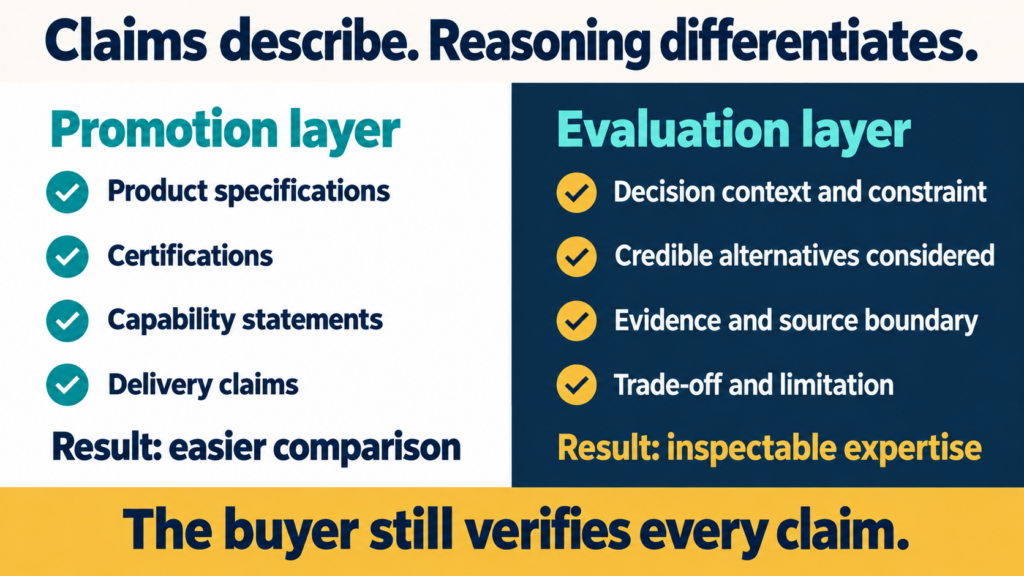
Google’s current guidance for generative-AI features uses the phrase “non-commodity content” for material that contributes a unique, useful viewpoint rather than recycling common information. It also states that conventional SEO foundations remain relevant and that meeting best practices does not guarantee indexing or appearance. The responsible conclusion is narrow: original, experience-based analysis is more useful than manufacturing many near-duplicate keyword variations; it is not a guarantee of search or AI visibility.
Proof: Google Search Central — optimizing for generative AI features
What a U.S. buying group cannot evaluate from company claims alone
A complex B2B decision rarely belongs to one person. Engineering may test technical fit. Operations may assess maintainability and continuity. Procurement may compare commercial exposure. Security, finance or legal stakeholders may examine a risk that never appears in the first sales conversation.
The 2025 Edelman–LinkedIn B2B Thought Leadership Impact Report draws on nearly 2,000 global professionals and distinguishes visible target buyers from “hidden buyers” inside the wider buying group. Edelman reports that hidden buyers consume and evaluate thought leadership and value ideas that inform or challenge their perspectives. This supports using expert material to help a broader group examine a decision. It does not prove that thought leadership will create advocacy or win a deal.
Proof: Edelman–LinkedIn 2025 B2B Thought Leadership Impact Report
The implication for a Japanese supplier entering or expanding in the United States is operational: do not design expert content only for the first visible contact. Make the decision, evidence and limitations legible to the people who may later review the recommendation.
Build one operating lesson before building a content campaign
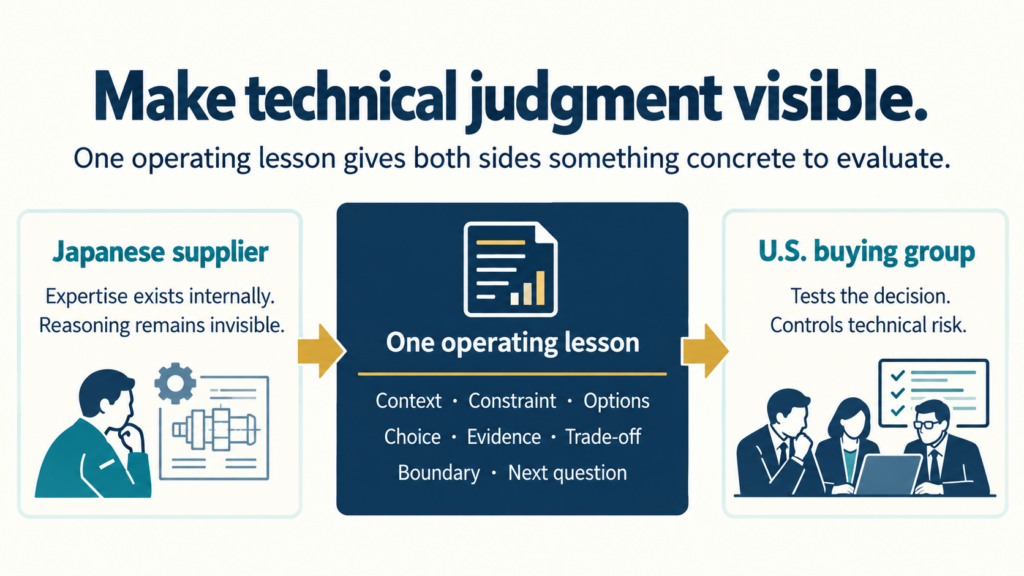
The safest starting unit is not “a thought-leadership article.” It is one approved operating lesson. The lesson should be narrow enough to verify and useful enough to change a decision.
Use this eight-part record:
- Context: What system, process or buyer decision was involved?
- Constraint: What made the decision difficult?
- Options: Which credible alternatives were considered?
- Choice: What was recommended or selected?
- Reasoning: Why did the evidence favor that choice?
- Trade-off: What improved, and what did the choice sacrifice?
- Boundary: When would the recommendation not apply?
- Next question: What should a buyer verify before using the lesson?
Supporting example: how Seeknet explains a marketing recommendation
Seeknet recommended that a Japanese foodservice automation supplier explore customers beyond traditional restaurants. The concern was that restaurant-led positioning could define the potential market too narrowly, while staffing shortages, production consistency and output capacity also matter in other foodservice settings.
The alternatives were to maintain a primary focus on restaurants, where the product category was familiar, or explore additional segments such as food retail and institutional kitchens. Seeknet recommended exploring the broader approach by starting with the operational problem rather than the industry label alone.
The trade-off was the need for more tailored messaging. Different segments can have different workflows, purchasing processes, production requirements and decision-makers. A broader target market would therefore require more than one generic campaign.
This example illustrates how Seeknet identified potential opportunities beyond the supplier’s initial target market and considered the messaging needed to reach different foodservice segments. At the time it was shared, parts of the recommendation were still at the proposal or implementation stage, so final measurable outcomes were not yet available. However, its value as a case example lies in the strategic reasoning behind the recommendation and the practical considerations involved in putting it into action.
The transferable method is to explain the problem, alternatives, recommendation and trade-off. To evaluate the equipment supplier’s technical expertise, a U.S. buyer would still need the supplier’s own explanation of a relevant technical choice and its supporting evidence.
Apply the same questions to a technical recommendation
For a technical purchase, use the decision record as a set of questions for the supplier. Start with the operating conditions that matter to your team: required output, available space, quality requirements, staffing and support. Ask the supplier to explain which of these conditions changes its recommendation.
Next, ask for a credible alternative and the reason it was not preferred. Request evidence for any claimed advantage, including the conditions under which it was measured. If a test or result is unavailable, record that limitation rather than treating the recommendation as proven.
Then identify the trade-off your team would accept and the condition that would make you reconsider.
Convert the lesson into a buyer decision matrix
The supplier’s lesson becomes valuable when another team can apply it without accepting the supplier’s conclusion in advance.
| Buyer test | What the supplier should show | Warning sign | Buyer’s next question |
|---|---|---|---|
| Relevance | The operating conditions under which the lesson applies | The lesson is presented as universal | Which condition would change your recommendation? |
| Alternatives | At least two credible paths that were considered | The chosen option is described as the only possible answer | What would make the rejected option preferable? |
| Evidence | The facts, tests, records or standards that informed the choice | Evidence is replaced by adjectives or unnamed experience | Which source supports the material claim? |
| Trade-off | Both the gain and the sacrifice created by the choice | Only benefits are disclosed | What risk or cost did this option preserve? |
| Boundary | A condition where the method does not apply | No limitations are stated | When should we stop using this approach? |
| Access | A realistic route for a qualified technical follow-up | A generic form promises access without an owner | Who triages the question, and when is an expert involved? |
This matrix is not a scoring system for universal supplier quality. It is a structure for evaluating one lesson in the context of one decision.
Test credibility without confusing the source
Useful expert analysis remains supplier-authored material. It should not be presented as independent proof. Buyers can evaluate it at three levels:
- Expert assertion: what the practitioner says was decided or learned.
- Company-controlled evidence: an approved technical record, test, methodology, dated documentation or authorized case description.
- External corroboration: an issuer record, standard, independent research or other source appropriate to the exact claim.
Forrester’s 2025 analysis of trusted information sources reports that B2B buyers rely on multiple categories and assign different trust levels to insiders, existing vendors, independent experts and outsiders. The lesson is not that every buying group follows the same hierarchy. It is that attribution matters: a vendor expert is not automatically independent, and a company claim should not borrow the authority of an unrelated source.
Proof: Forrester — B2B buyers rate their most trusted information sources
For every material claim, place the supporting source beside the claim or in a clearly mapped proof register. A homepage, search result or general company credential is not claim-level proof.
Make expertise useful before the sales call
The strongest test is simple: can a reader make a better decision even if they never contact the supplier?
A useful lesson should let the buyer:
- recognize the conditions where the reasoning applies;
- identify the evidence that still needs to be requested;
- understand a meaningful trade-off;
- detect when the recommendation is too broad;
- formulate the next technical question; and
- know which kind of expert should answer it.
If the article ends only with “contact us,” the supplier has described authority without transferring decision value. The content should first complete a useful job; a contact route should then support questions that remain.
Create a realistic expert-access path
Expert access does not require publishing a private calendar or promising an immediate response. It requires an owned process. State who triages the inquiry, what information the buyer should include, when a technical expert becomes involved and where the route ends.
Before sending a technical question, identify the team responsible for reviewing it and the information they need. Describe the operating conditions, the decision to be made and the evidence already available. Confirm how a specialist becomes involved instead of assuming that a general enquiry form provides direct engineering access.
This is where Article 05 connects to, but does not duplicate, Article 04. Article 04 asks whether the expert’s identity, responsibility, evidence and access can be verified. Article 05 asks whether the expert’s reasoning improves the buyer’s current decision.
The operating distinction for both sides
For the Japanese supplier
Do not begin with a publishing calendar. Begin with one lesson the technical team is willing and able to support. Confirm the factual source, disclosure boundary, reasoning, trade-off and owner. Then turn the lesson into a buyer tool. Preserve the same material facts and limitations when the English article is adapted into Japanese.
For the U.S. buying group
Do not reward confidence or technical density by default. Test whether the lesson is relevant to the current operating conditions, whether credible alternatives are acknowledged, whether material claims are sourced, whether limitations are visible and whether a realistic expert route exists.
The shared finish line
The supplier is no longer asking to be treated as different merely because it says it is different. It is giving the buying group a decision it can inspect.
That is the peer-to-peer shift: from “Here is what we sell” to “Here is how we reason, where the reasoning applies, what evidence supports it and what you should test next.”
About the Author
This article was contributed by the strategic team at Travel Growth AI, represented by CVO Icare Duplessy.
Icare Duplessy is a systems architect specializing in B2B growth, market entry and acquisition strategy. His work focuses on helping organizations translate legitimate technical capability into clear, evidence-backed positioning aligned with how modern buying groups evaluate suppliers.
Website: https://travelgrowth.ai/
LinkedIn: https://www.linkedin.com/in/ixlr84u2/
More from this Category
View All




Most Viewed Blog



More from this author