.svg)


2026.06.26
Web Marketing

How U.S. Buyers Verify the Technical Experts Behind a Japanese Supplier
Last Updated on 2026-09-17by Icare Duplessy
The direct answer
This article uses a five-link framework to help U.S. buyers evaluate a supplier’s technical experts: identity, current responsibility, decision evidence, corroboration, and a realistic access or escalation path. A title or company biography does not, by itself, document all five elements. A useful expert profile connects a named person to the decision the buyer must make and shows what is proven, what still needs evidence, and what does not apply.
For Japanese suppliers, the same chain turns legitimate expertise into something a buying committee can inspect without inflating credentials or exposing confidential client information.
Verification chain: named expert → responsibility and domain → decision evidence → corroboration → access or escalation.
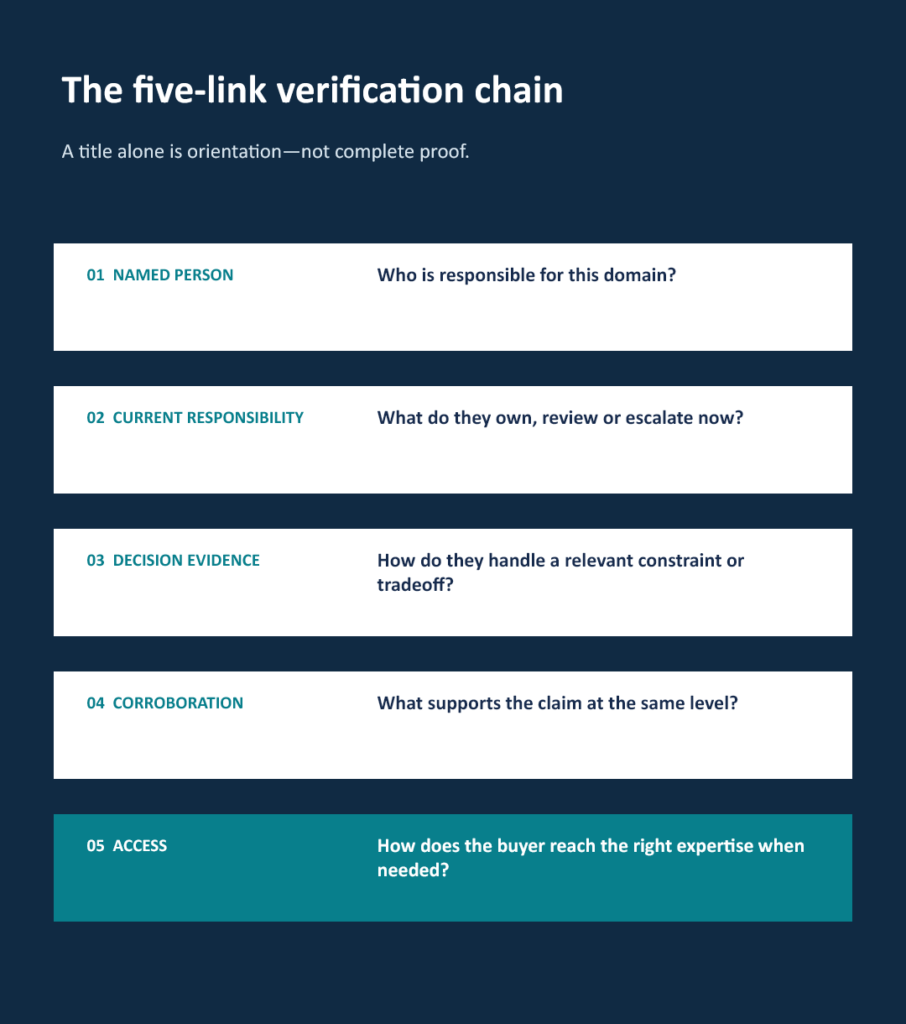
The five-link verification chain turns a title into a sequence of questions a buyer can inspect.
Why organization-level credibility is not enough for a technical decision
A buyer may value a supplier’s reputation and still need to know who will scope, review, implement or defend a technical decision. Engineering may examine technical fit. Operations may focus on continuity. Procurement may need evidence and accountability. Security, finance and an executive sponsor may each assess a different risk.
Government-backed guidance on evaluating IT supplier proposals recommends comparing technical knowledge, implementation track record, references, project-management capability, business understanding and viability. The relevant lesson is not that every buyer uses an identical scorecard. It is that organization-level claims should be connected to the people, process and evidence relevant to the decision.
Proof URL: https://www.nibusinessinfo.co.uk/content/evaluate-it-supplier-proposals
Digital self-service also matters. In Gartner’s survey of 632 B2B buyers conducted in August–September 2024, 61% preferred an overall rep-free buying experience. The same research found that buyer preferences change for tasks requiring contextual intelligence: respondents may prefer self-service for general research and seller input when judging fit. That combination supports a practical design rule—publish decision-useful evidence before the meeting, then make qualified expertise reachable when context is needed.
Proof URL: https://www.gartner.com/en/newsroom/press-releases/2025-06-25-gartner-sales-survey-finds-61-percent-of-b2b-buyers-prefer-a-rep-free-buying-experience
Forrester’s 2025 B2B trust research says buyers rely on different sources, with internal colleagues and management among the most trusted and independent experts also important. Our design implication is that a supplier’s expert page should help a buyer inspect and corroborate claims; it should not ask the buyer to accept self-description as proof.
Proof URL: https://www.forrester.com/blogs/b2b-buyers-rate-their-most-trusted-information-sources/
The goal is not to manufacture trust. It is to reduce avoidable uncertainty around legitimate expertise.
The five things a buyer should verify
1. Is the expert’s responsibility specific and current?
A strong profile explains what the person is responsible for now. It identifies the technical domain, the decisions the person owns or reviews, the limits of that authority and the person’s relationship to the supplier.
Compare:
- Weak: “A seasoned technology leader with extensive global experience.”
- Testable: “Leads solution architecture for manufacturing-data integrations and reviews technical scope before implementation handoff.”
The second statement is not automatically true, but it can be checked against current organization information, authored technical material, approved project evidence or a direct conversation.
Buyers should look for a full name, current title, defined domain, decision remit, organization relationship and a visible review date. Suppliers should avoid inflated titles, vague “visionary” language and biographies assembled from unverified profiles.
2. Can the expert show how relevant decisions are made?
A current issuer record can verify a credential itself. A separate decision example can show how the person reasoned through a real constraint.
Useful expert content explains a decision or tradeoff: how two integration approaches were compared, how speed was balanced against reliability, how a standards conflict was handled, or why a task was not automated. The example need not reveal a client or protected data. It needs enough context to show the reasoning.
Use this decision-evidence structure:
- Context: What system, process or environment was involved?
- Constraint: What limited the options?
- Choice: What was recommended or decided?
- Evidence: What informed the choice?
- Limit: When would the decision not apply?
The limitation is part of the proof. Expertise is easier to evaluate when the boundary of a method is explicit.
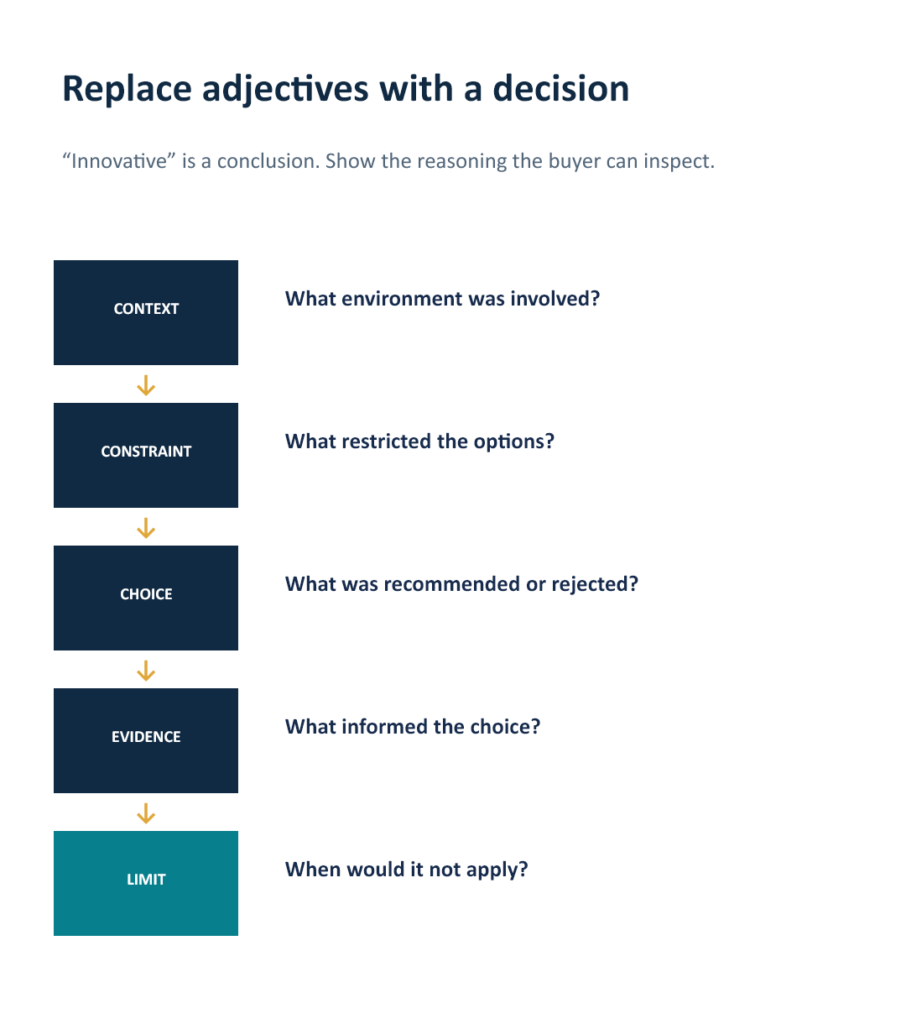
A useful expert example shows the reasoning behind a decision—and the boundary where that reasoning may not apply.
3. Can important claims be corroborated?
Corroboration does not require a wall of logos. It requires evidence that fits the claim.
Possible evidence includes a current issuer record for a credential, an authored technical article, an approved project description, a properly attributed client reference, a standards or publication record, a technical demonstration, or a documented review process.
Evidence must stay at the correct level. A company certification is not automatically a personal credential. A team result should not be assigned to one person without support. A project example should not disclose a client, result or protected method without permission.
When public corroboration is unavailable, the responsible options are to narrow the claim, state what can be disclosed, or reserve the proof for a controlled evaluation stage.
4. Is the guidance useful before a sales call?
An expert page should help a buyer make a better decision even if the buyer never contacts the supplier.
Useful material can include a diagnostic checklist, an implementation comparison, common failure modes, a standards interpretation, an annotated architecture or questions a buyer should ask any supplier. This lets the supplier demonstrate judgment while giving the buyer value without forcing a form submission.
5. Can the buyer reach the right expertise when it matters?
A page that names an expert but gives no handoff or escalation path leaves the next step unclear: the buyer still reaches a generic form with no indication of what happens next.
A realistic path can explain who triages technical questions, when the named expert participates, how implementation questions are handed off, and what escalation route exists after engagement. It need not promise unlimited direct access.
Do not promise direct access, response time or escalation authority unless operations can support the promise consistently. A precise, modest process is stronger than an impressive but unverified commitment.
Buyer checklist: verify before the first meeting
Use Yes / Evidence needed / Not applicable for each item:

The buying committee needs evidence matched to the decision each stakeholder owns. Illustrative AI-generated image; the people shown are not actual clients or Seeknet personnel.
- Is a real person named for the relevant technical domain?
- Does the profile state what the person owns, reviews or decides?
- Is the role current and clearly connected to the supplier?
- Does the expert show a relevant decision or tradeoff—not only credentials?
- Can the material claims be corroborated at the same level as the claim?
- Are projects, outcomes and client references used with permission?
- Does the expert explain limitations or conditions where a method does not apply?
- Is useful guidance available before a sales conversation?
- Is the access or escalation path realistic and explicit?
- Do English and Japanese versions preserve the same material facts and commitments?
“Evidence needed” is not an automatic disqualification. It identifies the question that should be resolved before the decision advances.
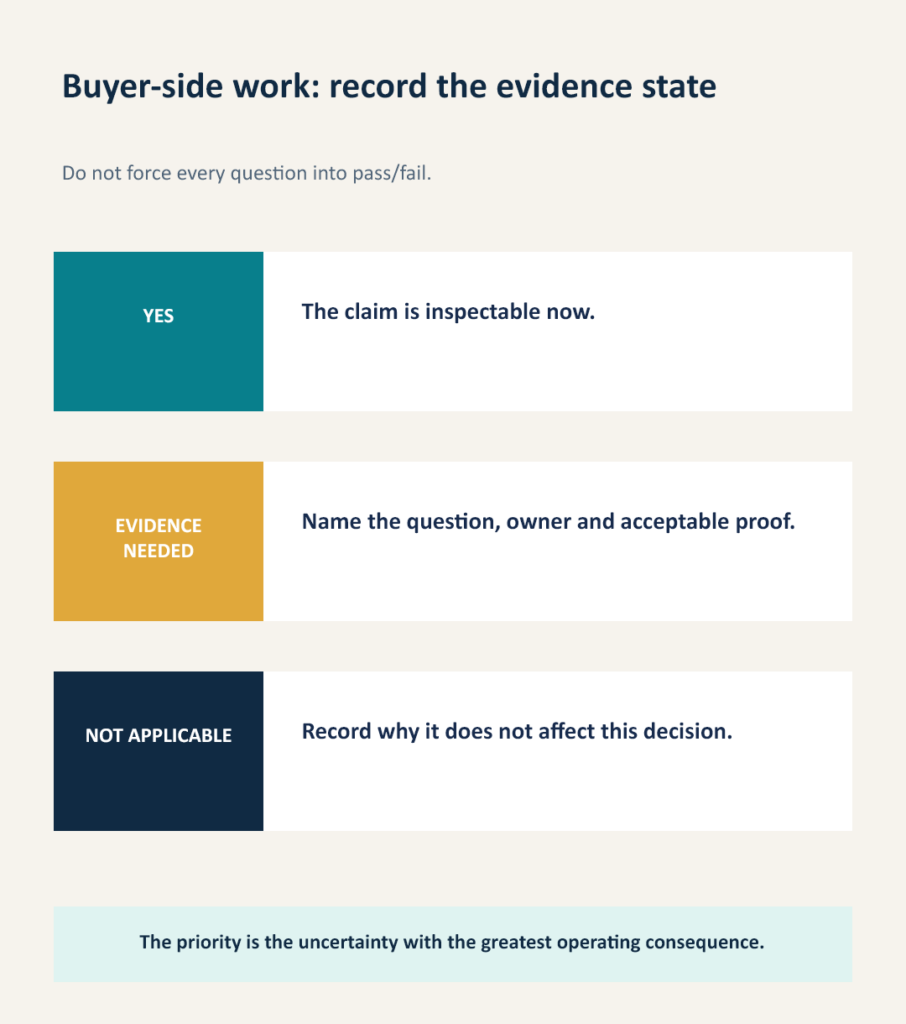
The proof matrix records uncertainty without forcing every question into a simplistic pass-or-fail judgment.
How Japanese suppliers can build a verifiable expert page

The supplier-side team verifies responsibility, decision evidence, permissions and English–Japanese parity before publication. Illustrative AI-generated image; the people shown are not actual Seeknet employees or partners.
Step 1: Select the expert who matches the buyer’s decision
Do not select a person only because they hold the most senior title. An executive sponsor, architect, engineering leader, implementation lead and service owner perform different jobs. Match the person to the buyer’s problem and state the difference.
Step 2: Obtain consent and verify every fact
Confirm the name, title, remit, organization relationship, credentials, project references, quotations, profile links and image rights. Record who verified each fact and when. For English and Japanese versions, name the authoritative source and the reviewer responsible for parity.
Step 3: Replace adjectives with decision evidence
“Innovative,” “world-class” and “trusted” are conclusions. Show the relevant domain, a decision pattern, an approved example and its limits so the reader can form a conclusion independently.
Step 4: Put corroboration next to the claim
Link a credential to the issuer. Connect a project statement to an approved record. Date technical guidance when recency matters. Do not force the reader to guess which source supports which statement.
Step 5: Define separate paths for the two audiences
A supplier operator may need an Expert Visibility & Proof Audit. A technical evaluator may need a Technical Expert Verification Checklist or a controlled way to submit a question. Do not send both audiences into one undifferentiated funnel.
Step 6: Maintain the profile as operational data
Assign an owner and review schedule. Update responsibilities, credentials, links, availability and translated versions when they change. Display a last-reviewed date where appropriate so outdated responsibilities are not presented as current.
Structured data helps machines understand; it does not prove expertise
Google describes ProfilePage markup as a way to help Search understand a page whose main focus is a person or organization affiliated with the site. Its documentation supports a Person or Organization as the main entity and can include links to matching external profiles. The markup must describe the visible page accurately.
Use Person, ProfilePage, Organization and Article relationships only where they are true. Use sameAs only for profiles that describe the same entity. Validate the markup, preserve visible-text parity and update dateModified when the visible profile information is materially edited.
Google does not guarantee that features using structured data will appear in search results. In this article’s evidence framework, markup is not treated as proof of expertise or buyer trust.
Proof URL: https://developers.google.com/search/docs/appearance/structured-data/profile-page?hl=en
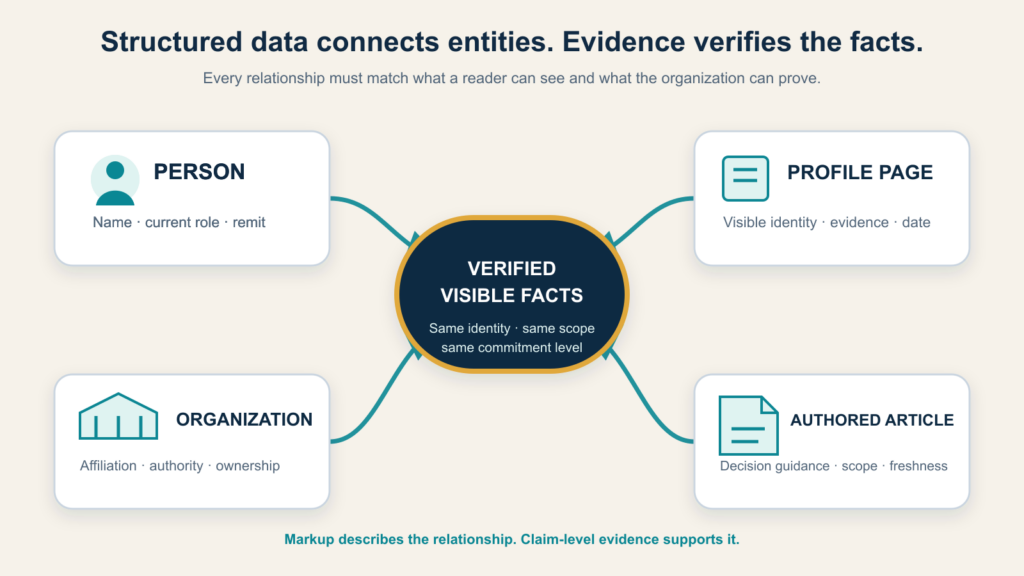
Structured data describes the relationship among entities; claim-level evidence supports the visible facts.
Frequently asked questions
What should a buyer look for in a supplier’s technical expert profile?
Look for a named person, a specific current responsibility, relevant decision evidence, claim-level corroboration and a realistic access or escalation path. Treat vague titles and unsupported superlatives as questions to verify.
Are certifications enough to prove technical expertise?
No. A current issuer record can verify the credential itself. Use separate evidence to evaluate current responsibility, decisions, project work and authored guidance.
How can a supplier show expertise without revealing confidential client information?
Describe the problem class, constraints, decision process, evidence used and limitations without naming the client or exposing protected data. Obtain permission before using an identifiable project, outcome, quotation or client relationship.
Does Person or ProfilePage schema make an expert more trustworthy in search?
No. Accurate markup may help search systems understand the page and its entities. It does not prove expertise or guarantee visibility, rankings, citations or trust.
Choose the path that matches your role
For Japanese supplier leaders and technical teams: use an Expert Visibility & Proof Audit to identify missing identity, responsibility, evidence, corroboration, localization and access elements before publishing an expert profile.
For U.S. technical evaluators and procurement teams: use the Technical Expert Verification Checklist to record what is proven, what requires evidence and what is not relevant to the current decision.
Both paths should remain useful before personal data is collected. If a reader chooses to submit information, the destination must explain purpose, consent, routing and follow-up. Analytics may measure the path, but measurement must not be presented as proof of trust or purchase intent.
About the Author
This article was contributed by the strategic team at Travel Growth AI, represented by CVO Icare Duplessy.
Specialized in bridging the gap between Japanese technical excellence and U.S. market authority, Travel Growth AI focuses on operator identity and authority matching to help Japanese B2B engineering and SaaS firms recalibrate their digital presence.
By moving from silent perfection to visible leadership, Icare helps firms reduce procurement friction and accelerate North American growth.
Website: https://travelgrowth.ai/
LinkedIn: https://www.linkedin.com/in/ixlr84u2/
More from this Category
View All



Most Viewed Blog


More from this author