.svg)


2026.06.26
Web Marketing

The Abandonment Paradox: De-risking Distance Through Localized Authority
Last Updated on 2026-06-17by Icare Duplessy
Many Japanese companies believe the hardest part of entering the U.S. market is being noticed. That is true, but it is only the first problem. Article 01 focused on visibility: why strong Japanese B2B companies can become invisible to U.S. buyers even when their products, engineering, and operations are strong. Article 02 moves to the next question: once U.S. buyers can see you, can they trust you enough to engage?
This is where the Abandonment Paradox appears. A Japanese company may be known for quality, discipline, reliability, and long-term thinking. Yet the same qualities that make the company strong at home may not automatically reduce risk in the mind of a U.S. buyer. The buyer may respect the company and still hesitate. The issue is not always product quality. It is often perceived distance. More specifically, it is the fear of being left alone when something goes wrong.
For Japanese companies selling into the U.S. market, this matters because buyers rarely say this directly. They may not tell you, “We were concerned about support time, local accountability, or decision-making speed.” They simply choose a competitor who feels easier to reach, easier to verify, and safer to explain internally.
The 13-Hour Decision Gap
The 13-hour decision gap is not only about time zones. It is about the buyer’s perception of operational latency. If a problem happens on Tuesday morning in Ohio, Texas, Georgia, or California, the buyer is not asking whether your headquarters in Japan is capable. The buyer is asking who can respond now, who has authority locally, and who will own the issue if the relationship becomes difficult.
This is why distance becomes emotional. To the seller, distance may be logistical. To the buyer, distance can feel like risk. They imagine delayed approvals, unclear escalation paths, slower support, language friction, and uncertainty around who is accountable. Even when those fears are not accurate, they still influence the decision.
This is the hidden cost of the abandonment paradox. A buyer may admire a Japanese company’s technical strength and still choose a weaker local competitor because the local competitor feels easier to manage if something goes wrong. In B2B buying, especially in manufacturing, technology, industrial services, logistics, and professional services, buyers are not only buying the solution. They are buying recoverability.
Why should you care? Because your company may be losing opportunities before the technical comparison even begins. Why should you believe it? Gartner describes the B2B buying journey as nonlinear and spread across multiple digital and human touchpoints, which means buyers evaluate risk before direct engagement. https://www.gartner.com/en/sales/insights/b2b-buying-journey Why should you act now? Because if your local accountability is unclear, the buyer may eliminate you before your sales team has the chance to explain it.
Why Strong Japanese Companies Lose to Weaker Local Competitors

Many Japanese firms assume that technical superiority will overcome buyer hesitation. In the U.S. market, this is not always true. Buyers often prefer the option they can understand, verify, and defend inside their organization. The best product does not always win. The safest perceived decision often wins.
A local competitor may have weaker engineering, less disciplined operations, or a less sophisticated product. But if that competitor clearly shows local support, response process, customer references, leadership visibility, and service accountability, they may feel less risky. The buyer can explain the choice more easily. Procurement can justify it. Operations can trust it. Finance can understand it. Leadership can approve it.
This is not irrational. It is how risk moves through a buying committee. A U.S. buyer is rarely making the decision alone. They may need internal agreement from procurement, legal, operations, IT, finance, compliance, and executive leadership. If the Japanese supplier’s value is difficult to explain, the internal champion must do extra work. If the support model is unclear, the champion must absorb extra risk. If local accountability is invisible, the champion may avoid the fight entirely.
Research reported by MarketingCharts shows that B2B buyers often do significant research before engaging with vendors. https://www.marketingcharts.com/industries/business-to-business-237346 That means buyers may already be forming conclusions about your local readiness before they contact your team. If your website, LinkedIn presence, case studies, and leadership profiles do not answer the abandonment question, buyers fill the gap themselves.
The practical lesson is simple: do not make U.S. buyers guess how your company will support them. If you have U.S. staff, show them. If you have local partners, explain their role. If you have local inventory, service coverage, implementation support, or escalation processes, make those signals visible. The buyer should not need a meeting to understand that you are not a distant supplier. They should see it before the meeting.
The Hidden Cost of Distance
Distance creates more than travel time. It creates doubt. The doubt may appear in several forms: response-time doubt, decision-authority doubt, communication doubt, service-continuity doubt, and internal-justification doubt.
Response-time doubt asks: if there is an urgent issue, how quickly will someone respond? Decision-authority doubt asks: can the U.S. team make decisions, or must every issue return to Japan? Communication doubt asks: will language, culture, or process slow the relationship? Service-continuity doubt asks: what happens after the contract is signed? Internal-justification doubt asks: can the buyer defend this decision if leadership challenges it?
For Japanese companies, this is important because many of these questions are not answered by product pages. A product page explains what you sell. It does not always explain how the buyer will be protected after the purchase. A company history explains credibility. It does not always explain local operating confidence. A translated website explains language access. It does not automatically create market trust.
This is why translation alone is not enough. A Japanese company can translate its website perfectly and still fail to reduce perceived risk. U.S. buyers do not only need English words. They need decision signals. They need to see proof that the company understands the U.S. buying environment, the buyer’s pressure, and the consequences of operational failure.
Nielsen Norman Group has shown that people often scan web pages rather than read every word carefully. https://www.nngroup.com/articles/how-users-read-on-the-web/ For B2B companies, this matters because buyers may scan your site looking for risk signals: local office, support model, response process, U.S. leadership, proof, case studies, and clear next steps. If those signals are buried, missing, or written in vague corporate language, the buyer may leave with more uncertainty than trust.
How U.S. Buyers Evaluate Operational Risk

U.S. buyers do not evaluate overseas suppliers only by capability. They evaluate risk transfer. They are asking, “If we choose this company, what risk moves onto us?” That risk can be operational, political, financial, technical, legal, or reputational.
A procurement leader may worry about vendor reliability. An operations leader may worry about downtime. A technical leader may worry about integration or support. A finance leader may worry about cost exposure. A senior executive may worry about being blamed if the vendor relationship fails. Each stakeholder sees the same supplier through a different risk lens.
This is why the abandonment paradox is so dangerous. A Japanese company may think it has already proven trust through quality, history, and reputation. But the U.S. buyer may be looking for a different kind of trust: local proof, fast support, clear accountability, visible expertise, and evidence that the company can operate inside the U.S. business environment.
This is also where thought leadership matters. The 2024 Edelman-LinkedIn B2B Thought Leadership Impact Report emphasizes the role of expert content in shaping how B2B decision-makers understand problems and evaluate potential partners. https://www.edelman.com/insights/hidden-buyer-b2b Thought leadership is not just branding. When done correctly, it helps buyers see how your company thinks, how you understand their risk, and how you approach complex decisions.
For Japanese firms, this creates an opportunity. You do not need to become louder. You need to become easier to trust. You can use content, leadership visibility, case examples, service documentation, and local proof to show buyers that distance will not become abandonment.
Localized Authority as the Trust Bridge
Localized authority means the buyer can see that your company is not only present in the U.S. market, but operationally accountable inside it. It is the difference between “we sell in the U.S.” and “we can support U.S. buyers with clarity, speed, and responsibility.”
This does not require changing the essence of the Japanese company. It requires translating operational strength into buyer-facing proof. If your company has disciplined processes, show how they protect the U.S. buyer. If you have strong engineering, show how it reduces operational risk. If you have U.S.-based leadership, make that leadership visible. If you have bilingual support, explain how it reduces communication friction. If you have implementation experience, show what the buyer can expect.
The strongest trust signals are often practical. Who is the U.S. contact? What happens after inquiry? What happens after onboarding? What happens if there is a problem? What support is available locally? What proof exists from similar customers? What can be verified before the buyer books a meeting?
This is also where structured information matters. Google Search Central explains that structured data helps search engines understand page content. https://developers.google.com/search/docs/appearance/structured-data/intro-structured-data Schema.org provides shared vocabulary that can help make information more machine-readable. https://schema.org This does not mean every company needs a complex technical implementation immediately. It means important information should be easy for humans and systems to understand: who you serve, where you operate, what you do, what proof exists, and how buyers can take the next step.
Localized authority should appear across the company’s digital environment: website, LinkedIn company page, executive profiles, service pages, technical documentation, case studies, articles, and contact pathways. If the signals are fragmented, the buyer experiences uncertainty. If the signals are aligned, the buyer experiences confidence.
The Domestic Accountability Model
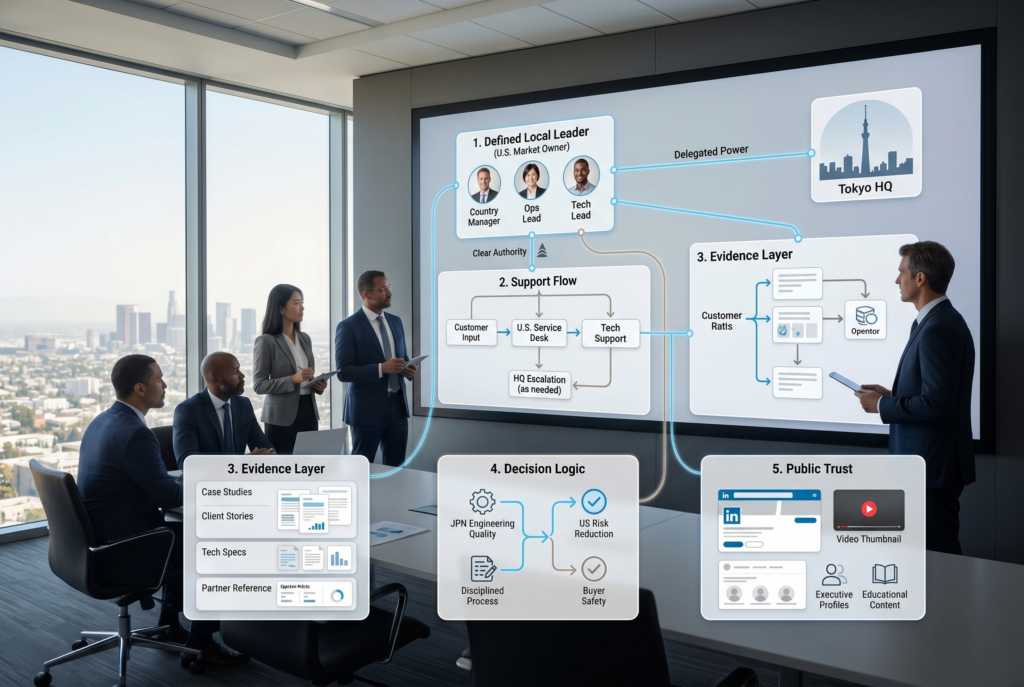
The goal is not to pretend the company is American. The goal is to make the U.S. buyer feel protected while preserving the company’s Japanese strengths. This is the domestic accountability model.
First, define the local owner. Buyers need to know who carries responsibility in the U.S. market. This may be a president, country manager, sales director, technical lead, operations lead, or partner. The person does not need to be famous. They need to be visible, credible, and clearly connected to buyer outcomes.
Second, define the support path. Buyers should understand how communication, escalation, and resolution work. If every issue appears to require headquarters approval, the buyer feels exposed. If the support path is clear, the buyer feels protected.
Third, define the proof layer. Buyers need evidence: client examples, implementation stories, technical documentation, partner references, service commitments, or operational metrics. Avoid unsupported claims. If a claim cannot be sourced, soften it or present it as an example.
Fourth, define the decision logic. Help buyers understand why choosing a Japanese supplier does not increase risk, but may reduce it. This is where the company can connect Japanese discipline, engineering quality, and long-term reliability to U.S. buyer concerns.
Fifth, define the public trust layer. Articles, executive commentary, LinkedIn updates, interviews, and educational content help buyers understand the company before the sales process begins. This is especially important because buyers often research before engaging.
Practical Actions Japanese Firms Can Take Now
Begin with a local-risk audit. Visit your website and LinkedIn presence from the perspective of a U.S. buyer. Can they quickly see what you do, who you help, why you are credible, who is accountable in the U.S., and what happens after they contact you? If not, the abandonment risk is still visible.
Next, rewrite your market-entry message around the buyer’s fear, not only your company’s strength. Instead of leading with “high quality Japanese manufacturing,” explain how your quality reduces downtime, improves consistency, lowers implementation risk, or protects operational continuity. Instead of saying “global support,” explain what support exists in the U.S. market. Instead of saying “trusted partner,” show the evidence that makes the trust believable.
Then, make leadership visible. U.S. buyers often trust people before systems. A clear executive presence can reduce distance. This does not mean aggressive self-promotion. It means showing judgment, accountability, and market understanding.
Finally, build content that answers the questions buyers are already asking: How do Japanese companies sell in the U.S.? How do U.S. buyers evaluate overseas suppliers? How can international suppliers reduce perceived vendor risk? How can companies build trust before the first sales conversation? How can local accountability help overseas suppliers win U.S. contracts?
The companies that answer these questions clearly will be easier to evaluate. The companies that remain silent will continue forcing buyers to guess.
Visibility Is Only the First Bridge
Article 01 addressed the first barrier: invisibility. Article 02 addresses the second: trust. Being visible is not enough if the buyer still feels exposed. The next step for Japanese companies is to reduce the fear of distance by making local authority, support, and accountability visible before the meeting.
The abandonment paradox is solvable. U.S. buyers do not need every supplier to be local. They need every supplier to feel accountable. They need to know who will respond, who will decide, who will support, and who will own the outcome when pressure appears.
For Japanese companies entering or expanding in the U.S. market, this is the practical shift: do not only prove that you are excellent. Prove that the buyer will not be abandoned.
That is how distance becomes manageable. That is how trust becomes visible. And that is how strong Japanese companies move from being seen to being selected.
About the Author
This article was contributed by the strategic team at Travel Growth AI, represented by CVO Icare Duplessy.
Specialized in bridging the gap between Japanese technical excellence and U.S. market authority, Travel Growth AI focuses on operator identity and authority matching to help Japanese B2B engineering and SaaS firms recalibrate their digital presence.
By moving from silent perfection to visible leadership, Icare helps firms reduce procurement friction and accelerate North American growth.
Website: https://travelgrowth.ai/
LinkedIn: https://www.linkedin.com/in/ixlr84u2/
More from this Category
View All



Most Viewed Blog


More from this author