
.svg)


2026.06.26
Web Marketing

Web Marketing in the AI Era: What Should Be Outsourced?
Last Updated on 2026-06-26by Nobuo Oyama
In recent years, the role of marketing professionals at Japanese companies doing business in the U.S. has expanded dramatically. They are now responsible for everything from AI search, Google Ads, and SEO to social media advertising, website optimization, CRM, and lead management. Not long ago, marketing initiatives could be managed individually—launching ad campaigns, creating SEO content, or redesigning a website. Today, however, success requires a more holistic approach that encompasses data analytics, AI readiness, cybersecurity, and conversion flow, in addition to traditional marketing activities.
For many Japanese companies operating in the U.S., limited in-house resources mean that marketing teams must simultaneously communicate with headquarters in Japan, align with local sales teams, and coordinate with agencies and vendors. As a result, it’s often unclear where to start, who to consult, and which tasks are best handled by which partner.
As AI, digital advertising, SEO, and web-related risks continue to evolve and become more complex, knowing when to bring in the right external expertise is more important than ever. In this article, we’ll explore the key areas where Japanese companies operating in the U.S. should consider partnering with external marketing experts.
AI, Advertising, SEO, and Web Risks Are Becoming Increasingly Complex
Focusing on Advertising or SEO Alone Is No Longer Enough
In the past, companies could make meaningful progress by managing their digital marketing initiatives separately—working with one agency for Google Ads, another for SEO content, and another for website development. However, these disciplines are now deeply interconnected. The success of paid advertising depends heavily on landing page quality and site performance, SEO results are influenced by content quality and site architecture, and marketing performance is increasingly measured across the entire customer journey, including CRM and lead management after an inquiry is submitted.
For example, even if your ad campaigns generate more clicks, conversions won’t increase if your inquiry form is confusing. Likewise, even if your SEO content drives more traffic, it’s unlikely to generate leads if visitors aren’t guided to relevant service pages or clear calls to action (CTAs). In other words, it’s no longer enough to optimize individual tactics—you need to manage the entire conversion flow, from search to inquiry.
Strong SEO Fundamentals and Trusted Information Still Matter in the Age of AI Search
With the growing use of generative AI and AI-powered search, some marketers may wonder whether traditional SEO is becoming outdated. In practice, however, accurate, original, and well-organized information on your website is becoming even more important in the age of AI search.
It can be tempting to focus on adding surface-level keywords or producing large volumes of FAQs simply to make content more likely to be picked up by AI. However, this approach can be counterproductive. Instead, it is important to understand the challenges customers in the U.S. market face and what information they look for before deciding to make an inquiry, and then communicate that knowledge through authoritative, expert content. AI SEO also starts with the basics: providing useful information for readers in a clear structure that search engines can easily understand.
In Advertising, Conversion Design Matters More Than Clicks
With Google Ads and social media advertising, looking only at clicks, impressions, and click-through rates in the ad platform is not enough to determine actual business results. For B2B companies in particular, what matters most is the quality of inquiries, their potential to become sales opportunities, and whether they are leads that the sales team should follow up on.
For this reason, advertising management should go beyond tracking which keywords generated traffic. It should also examine which pages visitors viewed before submitting an inquiry, where they dropped off in the form, and which leads are closer to becoming MQLs or SQLs. By connecting advertising, the website, CRM, and the sales process, companies can move beyond simply running ads and build a more effective lead generation system.
Common Web Marketing Challenges for Japanese Companies in the U.S.
Misaligned Performance Metrics Between Headquarters in Japan and U.S. Branch Office
Marketing teams at Japanese companies operating in the U.S. often face a gap in how success is measured. Headquarters in Japan may emphasize metrics such as website traffic, ad impressions, and the quality of marketing deliverables, while the U.S. branch office is more concerned with lead quality, how easily the sales team can follow up with prospects, and the likelihood of converting leads into sales opportunities.
Both perspectives are important. However, without clearly defined success metrics, it becomes difficult to evaluate marketing performance and make decisions. For example, deciding whether to increase ad spend, invest in additional SEO content, or improve the website requires a clear view of the entire lead generation process. By making the conversion flow visible and establishing shared performance metrics, companies can make better informed decisions. An experienced external marketing partner can help organize these discussions, align expectations across teams, and provide a common framework for decision-making.
Difficult to Find In-House Talent with Expertise Across SEO, Advertising, CRM, and Web Development
At many U.S. offices of Japanese companies, marketing teams are responsible for a wide range of activities, including public relations, trade shows, sales materials, website updates, digital advertising, and social media. In this kind of environment, it can be challenging to make informed decisions across SEO, advertising, CRM, web development, and systems integration.
When working with external partners, responsibilities can also become fragmented: advertising agencies handle advertising, web agencies focus on design and development, and technology providers handle technical issues. As a result, no single partner may take responsibility for the overall marketing performance. This is why it is important to have a partner who can look across multiple areas and help organize the challenges from a broader perspective.
The Website Functions as a Company Brochure, Not a Lead Generation Tool
U.S.-focused websites for Japanese companies may have well-organized company information, business details, and office locations, yet still lack the structure needed to generate leads. For example, when service pages do not clearly communicate target industries, service areas, key benefits, FAQs, case studies, and calls to action (CTAs), visitors may not have enough information to feel confident about making an inquiry.
A B2B website is more than a company brochure; it also serves as a sales tool that helps prospective customers decide whether your company is worth contacting. In the U.S. market especially, buyers often research and compare multiple companies online before reaching out. As a result, websites need to bring together trust-building, problem awareness, and a clear path to inquiry in a cohesive experience.
Core Areas to Consult External Marketing Partners
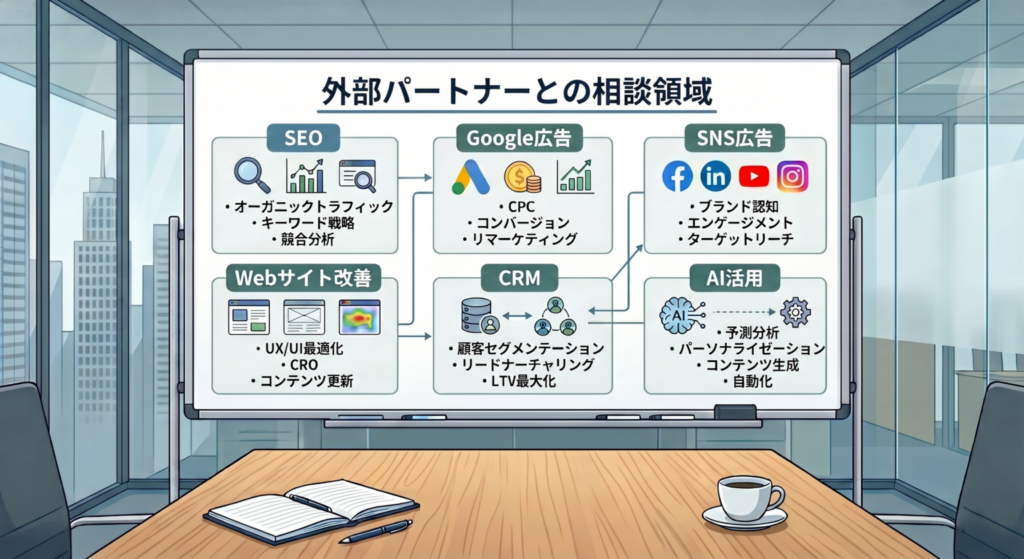
SEO & AI SEO: Designing Information That Get Chosen, Not Just Found
SEO is not simply about using keywords to improve search rankings. For Japanese companies operating in the U.S., content needs to be structured for multiple audiences, including local companies looking for your products and services, existing customers, prospective customers, and people at your headquarters in Japan.
Seeking support from an external partner is about more than deciding which keywords to target. A comprehensive SEO strategy should also address content structure based on search intent, internal links to service pages, FAQs, structured data, expert content, and consistency between English and Japanese information. From an AI SEO perspective, original information and a clear page structure are also becoming increasingly important.
Google Ads and Social Media Advertising: Designing a Conversion Path That Drives Results
Google Ads and social media advertising do not automatically deliver results simply because the campaigns are properly configured. To make informed decisions about ad spend, everything needs to work together—from ad copy, keywords, and targeting to landing pages, forms, conversion tracking, and lead quality.
For example, a keyword with a high cost per click (CPC) may still be worth investing in if it is likely to generate sales opportunities. On the other hand, if an ad generates a high volume of clicks but low-quality inquiries, the ad copy or landing page may need to be revisited. External partners should be able to look beyond the ad platforms themselves and recommend improvements with the post-inquiry sales process in mind.
Website Optimization: Design, Page Speed, Trust Signals, and Conversion Paths
When people think about website improvements, they may picture changes to the visual design. However, for effective lead generation, you need to look beyond aesthetics and optimize the entire user experience—including page structure, CTAs, forms, page speed, mobile responsiveness, security, and trust signals.
Especially in B2B, visitors do not always reach out after viewing a single page. They may read multiple pages, assess the company’s credibility, share information internally, and then decide whether to make an inquiry. That is why service information, track record, customer benefits, FAQs, and clear paths to inquiry need to work together naturally. Working with a partner who understands both web development and marketing can help drive improvements that go beyond visual design.
CRM and Measurement: Understanding Lead Quality and Using Insights to Improve Advertising and Sales
In B2B marketing, understanding lead quality is just as important as tracking the number of inquiries. After a form submission, it is important to determine whether a lead qualifies as an MQL, is closer to an SQL, or requires follow-up from the sales team. Without this visibility, it becomes difficult to use lead data to improve advertising and SEO strategies.
CRM and marketing tools make it easier to track which acquisition channels generate which types of leads. By incorporating feedback from the sales team into advertising and content creation, companies can continuously improve the quality of their lead generation. When working with an external partner, it is beneficial to seek advice not only on selecting and implementing the right tools, but also on establishing practical workflows and operating guidelines that teams can apply in their day-to-day work.
What to Look for When Choosing an External Marketing Partner
Can They Take a Holistic View of Advertising, SEO, Web Development, and Technology?
When choosing an external marketing partner, it is important to look beyond expertise in individual areas and consider whether the partner can understand how different marketing activities work together. A company that specializes primarily in advertising may overlook issues with landing pages or CRM. Similarly, a company focused mainly on web development may not be able to fully address traffic acquisition and conversion optimization after the site goes live.
For Japanese companies operating in the U.S. to achieve results, it is important to take an integrated view of SEO, advertising, the website, technology, and measurement. When speaking with a potential partner for the first time, rather than focusing on “which tactics should we implement?”, it is worth determining whether they can work with you to identify where the bottlenecks are and what should be addressed first.
Does the Partner Understand Both the U.S. Market and the Internal Dynamics of Japanese Companies?
For web marketing in the U.S. market, understanding English language nuances and local search is not enough. Japanese companies also have unique internal approval processes and reporting requirements. Even when a local office wants to move quickly on improvements, it may need to explain the initiative to the headquarters in Japan and obtain budget approval.
For this reason, an external partner needs both practical knowledge of the U.S. market and the ability to communicate effectively in Japanese. An important part of their role is to explain marketing concepts and technical terms in clear, accessible language and help present the rationale for proposed improvements in a way that can be effectively communicated to headquarters and senior management.
Can They Advise on Priorities and Cost-Effectiveness, Rather Than Just Execute Tasks?
When consulting an external marketing partner, you do not necessarily need to have a specific request in mind, such as “We want to run ads,” “We want to create more SEO content,” or “We want to rebuild our website.” In fact, when marketing results have stalled, it is often more important to first identify where to focus before deciding which tactics to implement.
With a limited budget, achieving results requires balancing initiatives that can generate inquiries in the short term with those that build trust and credibility over the longer term. An external partner should be more than a service provider that simply executes tasks. They should also be a partner you can turn to for advice on priorities, cost-effectiveness, and how to communicate marketing decisions internally.
When to Seek Help and How to Get Started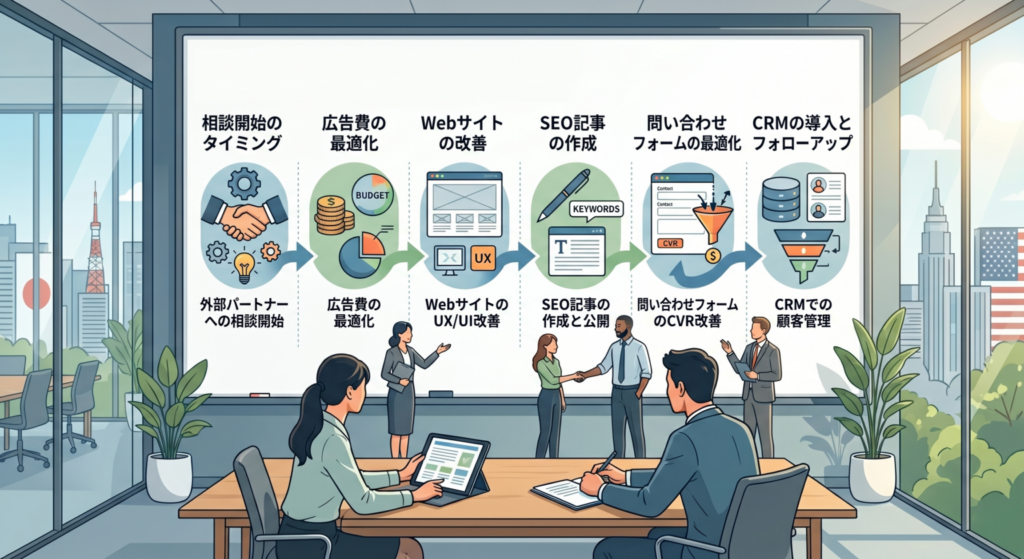
Before Increasing Ad Spend, Review Your Website and Measurement Setup
When advertising performance stalls, it is easy to focus on increasing the budget, adding more keywords, or changing the ad copy. However, if there are issues with the landing page content, form usability, conversion tracking, or lead management after inquiries, simply increasing ad spend is unlikely to produce significant results.
The first step is to determine whether the current website addresses prospective customers’ concerns, whether the path to inquiry is clear, and whether performance can be accurately measured for each advertising campaign. By reviewing these areas before optimizing ad campaigns, companies can move beyond simply generating clicks and more effectively focus on generating leads that are likely to become sales opportunities.
Before Creating More SEO Content, Clarify Search Intent and the Conversion Path
SEO content can be a valuable long-term traffic asset for Japanese companies operating in the U.S. However, simply increasing the number of articles does not necessarily lead to results. It is important to determine who the content is for, what questions or challenges it should address, and which service pages or conversion paths it should lead readers to.
Especially in B2B, readers do not always make an inquiry right away. They may first gather information, share it internally, and compare different options before deciding to reach out. For this reason, SEO content should be designed not simply to generate traffic, but to deepen prospective customers’ understanding and build trust in the company over time.
FAQ: Frequently Asked Questions About Working with External Marketing Partners
Q: Can I consult an external partner about advertising or SEO alone?
A: Yes. However, to accurately assess performance, it is recommended to look beyond advertising or SEO alone and also review the website, CTAs, forms, and measurement setup. For example, even if an ad has a high click-through rate, a lack of inquiries may indicate an issue with the landing page or form.
Q: How do I know whether to prioritize SEO or advertising?
A: If the goal is to generate more inquiries in the short term, advertising can be effective. On the other hand, if the goal is to strengthen organic search traffic and build trust over the longer term, SEO and content creation are important. In practice, the right priorities depend on factors such as budget, the competitive landscape, the current state of the website, and the sales structure. It is important to assess the current situation and distinguish between short-term and long-term initiatives.
Q: Can an external partner also help organize materials and proposals for the headquarters in Japan?
A: For U.S. offices of Japanese companies, there are often situations where the need for marketing initiatives must be explained to the headquarters in Japan. In these cases, it is important not only to execute tasks but also to clearly organize the current challenges, improvement priorities, and expected outcomes. When choosing an external partner, it is worth confirming whether they can also prepare proposals in a format that can be used for internal communication with the headquarters.
Conclusion: Rethinking U.S. B2B Lead Generation as a Whole, Not Just Individual Tactics
As AI, advertising, SEO, websites, CRM, and measurement environments become increasingly complex, it is becoming more difficult for Japanese companies operating in the U.S. to evaluate their web marketing efforts based on individual tactics alone. Going forward, it is important to take an integrated view of search traffic, advertising, the website experience, conversion paths, and lead management.
The value of working with an external marketing partner is not simply to outsource tasks. It is to help identify the company’s challenges, determine which initiatives should be prioritized, and build a path toward results within limited budgets and internal resources.
Seeknet USA provides integrated support for Japanese companies operating in the U.S., covering website development, digital marketing, and system development. If you are facing challenges with advertising, SEO, AI, website optimization, or lead generation, we would be happy to start by reviewing your current situation and identifying areas for improvement. Feel free to reach out to us.
Reference Articles:
有用で信頼性の高い、ユーザーを第一に考えたコンテンツの作成 | Google 検索セントラル | Documentation | Google for Developers
Google 検索の生成 AI 機能向けに最適化するための Google のガイド | Google 検索セントラル | Documentation | Google for Developers
Google タグを使用して拡張コンバージョン(ウェブ向け)を設定する – Google 広告 ヘルプ
95-5 Rule | LinkedIn Marketing Solutions
構造化データ マークアップとは | Google 検索セントラル | Documentation | Google for Developers
More from this Category
View All



Most Viewed Blog




More from this author
