.svg)



2025.05.09
Web Marketing
UTM Parameters Explained: A Complete Guide for Marketers on Basics and Implementation
Last Updated on 2025-04-25by Nobuo Oyama
Index
- Introduction
- What are UTM parameters?
- Why should you use UTM parameters?
- UTM Parameter Types
- How UTM parameters are generated
- How to set UTM parameters
- How to manage UTM parameters
- Things to keep in mind when using UTM parameters
- Conclusion
Introduction
In digital marketing, accurately understanding which measures are producing results is extremely important when considering your next move. For companies that operate multiple channels (SNS ads, email campaigns, listing ads, etc.), it is essential to visualize the performance of each channel.
This time, we will take a detailed look at “UTM parameters,” which are essential for such analysis . In this article, we will explain in an easy-to-understand manner for corporate marketing personnel everything from the basics of UTM parameters to how to actually set and manage them, and points to note when using them.
What are UTM parameters?
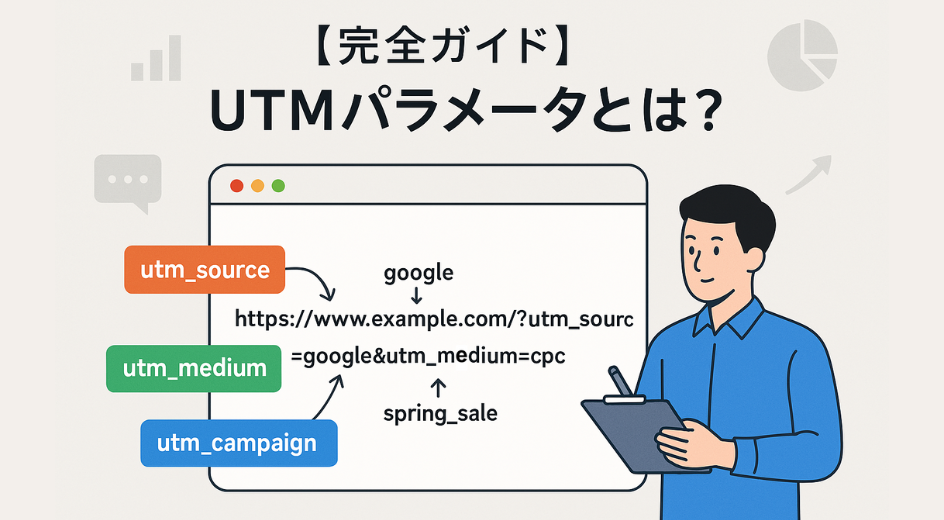
UTM parameters are “tracking parameters” added to the end of a URL and are used in access analysis tools such as Google Analytics to measure the source of website visitors and the effectiveness of campaigns.
For example, have you ever seen a link like this:
https://www.example.com/?utm_source=facebook&utm_medium=social&utm_campaign=spring_sale
The string after “?utm_ ~” is the UTM parameter. Google Analytics can read this information and analyze “where“, “how“, and “what” the visit came from.
Why should you use UTM parameters?
By using UTM parameters correctly, you can:
- Visualize the effectiveness of each channel and campaign. You can analyze the effectiveness by comparing multiple channels, such as
social medi , email, and advertising. - Optimize your budget allocation. This allows you to focus your resources on channels that produce better results.
- Improve report creation accuracy. By creating reports based on numerical values, you can make them more persuasive to both internal and external stakeholders.
- If there are many clicks that lead to identifying areas for improvement but low conversions, it will be easier to lead to the next action, such as improving the landing page.
UTM Parameter Types
UTM parameters mainly consist of the following five parameters (three of them are required parameters: “utm_source”, “utm_medium”, and “utm_campaign”).
- utm_source
- Example: google, facebook, newsletter
- It tells you where your visitors are coming from.
- utm_medium (medium)
- Example: cpc (pay per click) , social, email
- Identify the means by which it arrived.
- utm_campaign (campaign name)
- 例:spring_sale, holiday2025
- It is used to distinguish and measure the effectiveness of each measure or campaign.
- utm_term (keyword)
- Used to organize keyword information used in listing ads, etc.
- utm_content (content identifier)
- This is used to distinguish between multiple links within the same advertisement or link.
How UTM parameters are generated
Generating UTM parameters is easy using the “Campaign URL Builder” provided by Google.
【procedure】
- Access Google’s “Campaign URL Builder”
- Enter each item (source, medium, campaign, etc.)
- Copy and use the automatically generated URL
We also recommend creating your own company’s UTM management template using Excel or Google Spreadsheets.
How to set UTM parameters
Once you have generated a UTM URL, place it in a location like these:
- Link to your social media post ( Instagram, Facebook , etc.)
- Links in the newsletter
- Banner Ad Links
- Links in the press release
For example, if you were to run a spring promotion on Facebook:
https://www.example.com/special/?utm_source=facebook&utm_medium=social&utm_campaign=spring_sale
By setting this, you will be able to track traffic from the “Spring Campaign via Facebook”.
How to manage UTM parameters
As operation continues for a long time and multiple channels are used, UTM management becomes complicated. Therefore, we recommend centralized management using the following methods:
- Manage URL lists in a spreadsheet
By recording who used which parameters and when, you can prevent duplication and misuse. - Standardize naming rules (naming conventions)
Example: Establish consistent naming rules within the company, such as utm_source=facebook , utm_medium=social. - Parameter templating
It is efficient to create and reuse templates for frequently used campaigns and sources of traffic.
* If you refer to the table below showing the source names and default channel comparisons, your sources will be collected in the default channels provided by Google Analytics.
Download a spreadsheet of GA4 default-channel-group sources and categories
* For information on how to name utm_source and utm_medium to determine which default channel they will be aggregated on, please refer to the following page. [GA4] Default Channel Group
Things to keep in mind when using UTM parameters
- Stick to a consistent naming convention.
If you enter the same Facebook ad in different ways, such as “ fb ” and “ Facebook ,” Google Analytics will recognize them as different ads. - Utilizing shortened URLs Since long URLs with UTMs can be hard to read on social media or in print.
It is a good idea to use a URL shortening service such as Bitly. - Conduct testing and verification.
Before distribution, get into the habit of actually clicking on the link to check that it is being tracked correctly. - As mentioned above, there are default channels provided by Google Analytics.
Be sure to regularly check whether the UTM parameters you set are being properly categorized and displayed on the Google Analytics side.
Conclusion
UTM parameters are a very powerful tool for measuring the effectiveness of digital marketing. However, if the settings and operation rules are insufficient, the reliability of the data may decrease and accurate judgments may not be possible.
For Japanese companies conducting marketing in the US market, making effective use of UTM parameters will lead directly to building more accurate strategies.
If you want to make your company’s UTM operations more efficient, or if you want to consult with us about tracking and report design in GA4, please contact us at Seeknet USA. We will consistently support your marketing activities, from optimizing UTM to designing and executing an overall web marketing strategy.
More from this Category
View All




Most Viewed Blog




More from this author