.svg)




2025.05.09
Web Marketing
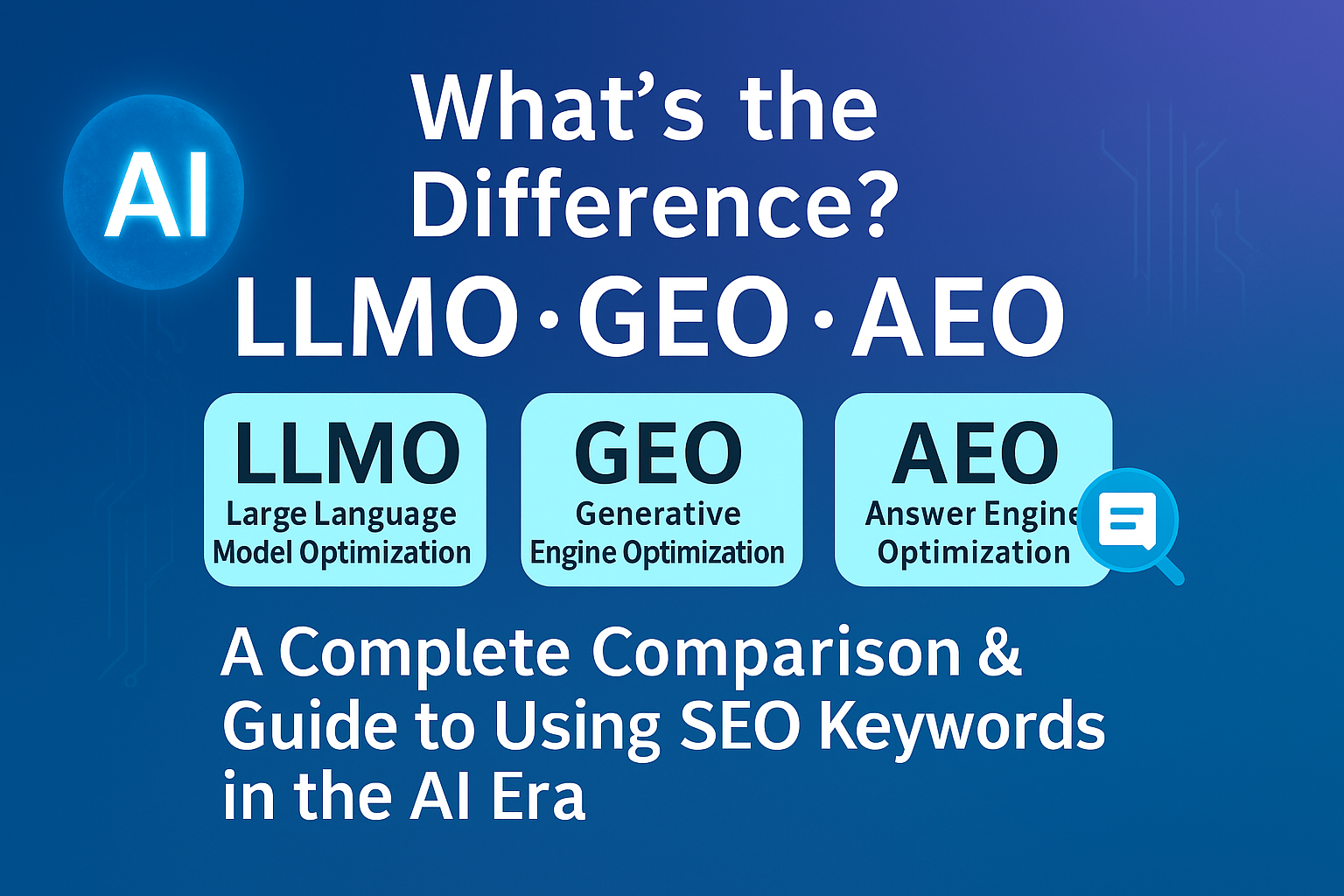
LLMO vs. GEO vs. AEO: Understanding SEO in the Age of AI
Last Updated on 2025-07-25by Nobuo Oyama
Index
- Quick Overview: Key Differences and Common Ground Between LLMO, GEO, and AEO
- Deep Dive 1: What is LLMO? Optimizing for Large Language Models like ChatGPT
- Deep Dive 2: What is GEO? Structuring Content for AI-Powered Search Engines
- Deep Dive 3: What is AEO? Building Answer-Friendly Content for Google and AI
- Comparison Table: A Side-by-Side Look at LLMO, GEO, and AEO
- FAQ: Which Should You Prioritize and How to Combine Them?
- Conclusion: Choosing the Right SEO Strategy for Your Business
🧭 Quick Overview: Key Differences and Common Ground Between LLMO, GEO, and AEO
LLMO, GEO, and AEO are relatively new concepts that have emerged with the rise of AI-powered search.
They all share a common goal: designing and structuring content in a way that makes it easy for AI and search engines to understand and trust.
However, they differ in target technologies and optimization goals:
-
LLMO: Optimizes content to be referenced by large language models like ChatGPT and Claude.
-
GEO: Aims for visibility in AI search engines like Perplexity and Google SGE.
-
AEO: Focuses on making your content extractable as direct answers in Google Search and AI assistants.
In simple terms: they differ in who you’re speaking to and how you’re delivering your message.
This article breaks down each one, showing how to apply them in real-world SEO efforts.
🧠 Deep Dive 1: What is LLMO? Optimizing for Large Language Models like ChatGPT
LLMO (Large Language Model Optimization) focuses on making your content easily referenced by AI systems like ChatGPT and Claude.
This isn’t about search rankings—it’s about being quoted inside AI-generated answers.
Key principles of LLMO:
-
Clear heading structure using H2/H3
-
Data and examples with sources
-
Author/company transparency
-
Concise, context-rich explanations
AI values coherence, consistency, and verifiability—your writing should help it confidently pull and present your information.
LLMO vs. “AI SEO”
While “AI SEO” is a general marketing term, LLMO is more specific. Think of AI SEO as the umbrella, and LLMO as a concrete, targeted tactic within it.
To use AI SEO effectively, you need to define who you’re optimizing for—LLMs, AI search engines, or traditional Google.
⚙️ Deep Dive 2: What is GEO? Structuring Content for AI-Powered Search Engines
GEO (Generative Engine Optimization) focuses on optimizing content for AI-powered search engines like Perplexity, You.com, and Google’s SGE (Search Generative Experience).
Unlike traditional search, these systems generate answers using your content. GEO ensures your site is picked as a source in those summaries.
Why GEO Matters Now
Google’s SGE uses AI to infer user intent and present summarized answers.
Other tools like Perplexity explicitly cite URLs, which means your site can be featured as a source, not just a result.
GEO vs. Related Terms:
|
Term |
Target |
Focus |
|
GEO |
AI search engines |
Structure and credibility for citations |
|
SGE Optimization |
Google‘s SGE |
Google-specific strategies like FAQ use |
|
AI Search Optimization |
General |
Often Overlaps with GEO and LLMO |
🎯 Deep Dive 3: What is AEO? Building Answer-Friendly Content for Google and AI
AEO (Answer Engine Optimization) aims to make your content easily extracted as the “best answer” by AI, Google, or voice assistants.
AEO is especially effective for:
-
Definition-style searches (“What is X?”)
-
How-to questions and step-by-step queries
-
Voice and smart assistant queries
AEO Success = Structure + Trust
To get picked as a top answer, content should:
-
Be organized as Q&A or FAQ
-
Use structured data like
schema.org -
Highlight E-E-A-T: experience, expertise, authoritativeness, and trustworthiness
This boosts your chance of being featured in Google’s featured snippets or “People Also Ask” boxes.
AEO vs. Rich Results SEO
While Rich Results SEO enhances visual presentation, AEO improves semantic understanding.
AEO is about answer accuracy—it helps AI understand your content, not just decorate it.
Why AEO Matters in the AI Era
AI no longer just reads text—it evaluates “what answers what question” through structure and context.
Strong AEO creates a foundation for AI to interpret and quote your content accurately.
🔍 Comparison Table: LLMO, GEO, and AEO Side-by-Side
|
Criteria |
LLMO |
GEO |
AEO |
|
Target |
ChatGPT, Claude, etc. (LLMs) |
Perplexity, You.com, Google SGE |
Google, Voice Search, AI assistants |
|
Goal |
Get quoted in AI-generated answers |
Be cited as a source in AI search |
Be extracted as the best direct answer |
|
Focus |
Trust, coherence, source clarity |
Structure, authority, freshness |
Questions, FAQ, E-E-A-T structure |
|
Related Term |
AISEO |
SGE Optimization |
Rich Result SEO |
❓ FAQ: Which Should You Prioritize and How to Combine Them?
Q1: Where should I start?
Start with AEO—it’s the easiest to implement through FAQ structure and schema markup.
Then enhance your overall content structure (GEO), and finally adjust your tone and writing style to favor LLM citations (LLMO).
Q2: Can traditional SEO still coexist with these strategies?
Absolutely. Keyword research, internal linking, and page speed are still valid.
What’s changed is the weight on clarity and trust, not just keyword density.
Q3: Can I trust AI SEO service providers?
Be cautious. Ask:
-
Do they know the differences between LLMO, GEO, and AEO?
-
Can they explain what exactly they’re optimizing and for whom?
Only partner with providers who can clearly answer those questions.
✅ Conclusion: Choose the Right SEO for Your AI-Driven Future
We’re entering an era where SEO is less about ranking—and more about being selected by AI and search engines.
-
Want to be quoted in ChatGPT? → Focus on LLMO
-
Want to be cited as a source in Perplexity? → Use GEO
-
Want to be chosen as a clear answer in Google? → Apply AEO
You don’t have to do everything at once. Start with what aligns best with your business goals, then build from there.
Need help getting started with AI-era SEO?
If you’re unsure where to begin or want to optimize existing content, Seeknet USA is here to help.
Contact us today for a consultation—we’re just a click away!
More from this Category
View All




Most Viewed Blog



More from this author